Seryosha Garcia Alvarez
World War ZSeryosha Garcia Alvarez is the Cuban voice who interprets the Zombie War through the history of a country that survived not only the dead but also the political system that had defined it. Speaking from a corner office on the sixty-ninth floor of the Malpica Savings and Loans building in Cienfuegos, he looks over an energy-independent metropolis and a busy harbor, using that changed landscape as evidence that Cuba’s victory was material, institutional, and civic. His testimony links early quarantine, military preparation, wartime production, contact with Nortecubanos, and the difficult birth of democracy.
Identity and Setting
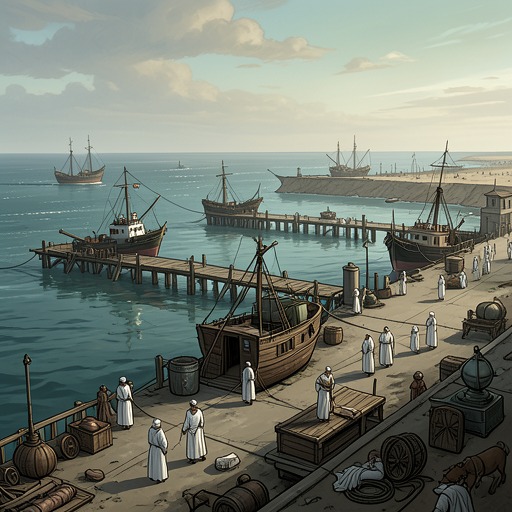
Seryosha Garcia Alvarez invites the interviewer to his office and promises a view that will not disappoint. The office occupies the second-tallest building in Cuba, after Havana’s José Martí Towers, and overlooks both the city and its harbor. At the “magic hour,” photovoltaic windows catch the setting sun in an almost imperceptible magenta hue. This carefully chosen setting gives his account a visual argument: the Cuba he represents is no longer the deprived, isolated island of his childhood, but a prosperous and technologically modern society built after the war.
His authority is experiential rather than institutional. He speaks as a Cuban who remembers rationed food, rationed fuel, long lines, hushed voices, and the political uses of the United States blockade. He describes the prewar country as living under quasi-isolation, comparing its deprivation to Great Britain during the Blitz while emphasizing that the blockade also served Fidel as a permanent explanation for hardship and a justification for remaining in power. Garcia Alvarez therefore narrates national survival from inside the contradiction between genuine external pressure and domestic authoritarian control.
Cuba Before and During the Outbreak
Garcia Alvarez explains that Cuba was spared the first wave of mass migration because travel from the United States was still largely prohibited. The earliest cases were limited and quickly contained, consisting mostly of Chinese refugees and a few European businessmen. Cuba suspended internal travel, mobilized both the regular army and territorial militias, and used its unusually high proportion of doctors per capita to understand the infection weeks before the first outbreak became a global crisis.
The island’s repressive fortress society made those measures possible. The government could restrict movement and impose containment before the Great Panic, when other governments finally recognized the nightmare at their doors. Geography supplied a second defense: Cuba did not face large overland swarms. Its attackers arrived by sea, aboard an armada of boat people who carried both contagion and competing ambitions to rule their new homes as modern conquistadors. Garcia Alvarez’s account thus distinguishes between the biological threat and the human political threat that traveled with it.
The wider Chinese response is part of the same historical landscape. At Old Dachang, patients were removed from a meeting hall in shackles and gags, a boy was carried out in a body bag, and villagers were rounded up for examinations by men who claimed to represent the Ministry of Health but were recognized as the Guoanbu. Garcia Alvarez’s Cuba follows a different route to control: it relies on surveillance and coercion, but its early containment also depends on medical expertise and the geographic limits of the island’s exposure.
The Arsenal of Victory
Garcia Alvarez’s central claim is that Cuba won the Zombie War. He acknowledges the scale of the suffering elsewhere, yet asks readers to compare the Cuba of twenty years earlier with the country that emerged after the conflict. The decisive change came when world governments went on the attack. Cuba became “the Arsenal of Victory”: a breadbasket, manufacturing center, training ground, and springboard; an air hub for North and South America; and a great dry dock capable of servicing ten thousand ships.
The war transformed Cuba’s economy as dramatically as it transformed its strategic importance. Money flowed into the island, creating an overnight middle class and a thriving capitalist economy that required the refined skills and practical experience of the Nortecubanos. Garcia Alvarez does not describe this prosperity as an isolated Cuban achievement. Cuba helped the Nortecubanos reclaim their nation, while the Nortecubanos helped Cuba reclaim its own.
That exchange altered political imagination as well as labor and production. The Nortecubanos showed Garcia Alvarez’s countrymen democracy and freedom not as vague abstractions, but as individual, practical capacities: the freedom to want a future and to fight for it. Their willingness to risk their lives for their dreams exposed the weakness of a regime that had long depended on fear of enemies at the gates. The war therefore becomes, in his telling, a channel through which military alliance turns into civic education.
Fidel and the Democratic Transition
Garcia Alvarez is astonished that Fidel recognized the approaching tide of freedom and managed to ride it. He describes the former ruler’s final political maneuver with amused admiration: Fidel embraced Cuba’s new democracy and claimed credit for creating it, then personally presided over the first free elections, making his last official act a vote that removed himself from power. Because he accepted the transition rather than resisting it through massacre, his legacy became a statue rather than bloodstains on a wall.
The outcome is not presented as idyllic. The new Latin superpower has hundreds of political parties, even more special-interest groups, frequent strikes, riots, and protests. Garcia Alvarez treats this disorder as the unavoidable cost of political plurality. His invocation of Churchill’s judgment that democracy is the worst form of government except for all the others captures his mixture of skepticism and commitment: freedom produces noise, conflict, and inefficiency, but authoritarian order had produced deprivation, fear, and arrested possibility.
Narrative Role and Significance
Garcia Alvarez’s testimony gives the postwar world a national case study in which emergency powers do not simply restore the old order. Cuba’s quarantine system contains the dead, wartime mobilization makes the island indispensable, international cooperation creates new wealth, and contact with Nortecubanos supplies a vocabulary for democratic citizenship. The sequence is causal rather than merely celebratory: survival creates capacity, capacity creates prosperity, prosperity expands social expectations, and expanded expectations make political change possible.
His account also complicates the book’s recurring opposition between freedom and centralized command. Other survivors describe governments that respond to catastrophe through secrecy, forced examinations, abandonment of civilians, decimation, or nuclear sacrifice. Garcia Alvarez remembers that Cuba’s fortress society could act quickly precisely because it was repressive, yet he also shows that the same crisis eventually helped dissolve the political structure that made such control possible. His office above Cienfuegos becomes the emblem of that double inheritance: modern infrastructure and economic confidence standing over the memories of scarcity, blockade, and fear.
For Garcia Alvarez, Cuba’s victory is therefore more than the prevention of a national extinction. It is the recovery of a country’s ability to imagine itself differently. The island defeats the infection, becomes a logistical engine for the wider counteroffensive, and then discovers that the people who helped save other nations have also acquired the power to demand their own. That is why his testimony treats the Zombie War as both a military triumph and an unfinished democratic revolution.